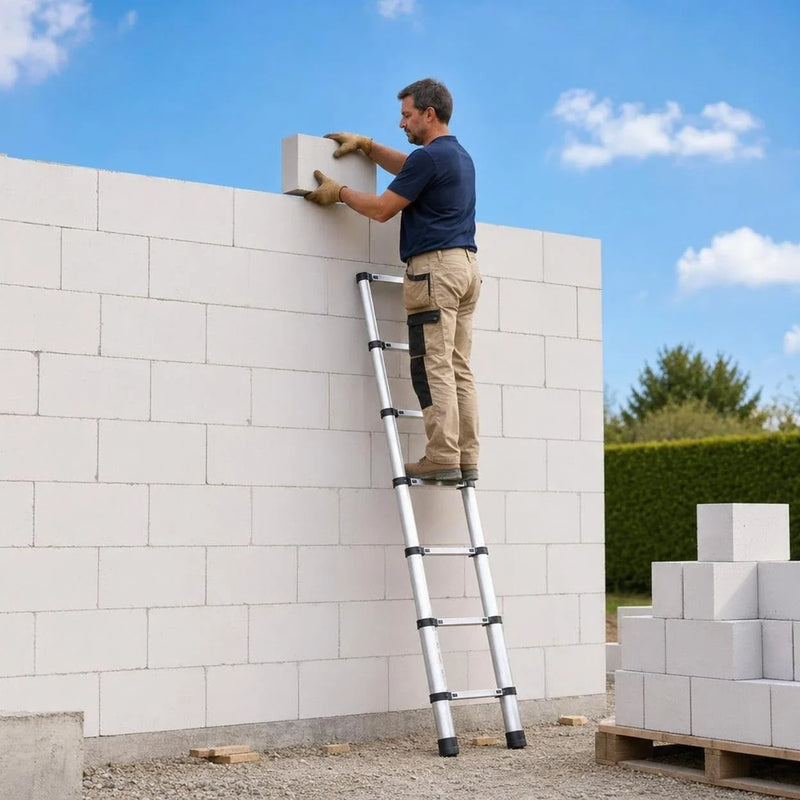
Guide · The right height
Which ladder height for which job?
No question makes people hesitate longer in front of a product page than this one. And it is the one buying mistake you cannot put right afterwards: a ladder that is too short is useless, one that is too long becomes unwieldy and dangerous.

Ladder length is not the same as working height
This is the misunderstanding that costs the most. When a product is described as a ‘3.8 m ladder’, that is the length of the extended ladder, measured along the stiles. It is neither the height you stand at nor the height you work at.
Two things reduce this figure, one increases it.
First, a leaning ladder never stands vertically. It leans against the wall at an angle of about 75 degrees, which loses a little vertical height. Second, you never climb onto the top rungs: you need something to hold on to. On the other hand, your arms add about two metres to the height your feet are standing at.
Actual working height = ladder length minus about 1 metre of safety margin at the top plus about 2 metres of arm reach.
The table for your situation
This is what the heights in our range look like when you apply this calculation. The right-hand column is the one that matters if you want to get to a gutter or onto a roof: the ladder must then extend about one metre beyond the point where you step off.
| Ladder length | Working height | Access to roof or gutter |
|---|---|---|
| 2.6 m | approx. 3.5 m | up to 1.5 m |
| 3.2 m | approx. 4.1 m | up to 2.1 m |
| 3.8 m | approx. 4.7 m | up to 2.7 m |
| 4.4 m | approx. 5.2 m | up to 3.2 m |
| 5.1 m | approx. 5.9 m | up to 3.9 m |
| 6.2 m | approx. 7.0 m | up to 5.0 m |
Calculated for a ladder angle of 75 degrees and a person about 1.75 m tall. Rounded to the nearest 10 cm.
Translated into real jobs
If you do not know which row of the table applies to you, start from the job you want to do.
- Fitting a wall light, changing a light bulb in the stairwell, cleaning a door canopy: you are working at between 2.50 m and 3 m, with a wall to lean against. A 2.6 m ladder is plenty. For a ceiling in the middle of a room, where there is nothing to lean against, you need a stepladder instead, for example a multi-purpose ladder.
- Cleaning a garage gutter, trimming a tall hedge, cleaning ground-floor windows: working height of around 4 m. A 3.2 m or 3.8 m ladder.
- Painting a façade, fitting shutters, working on a first-floor window: you are at a working height of between 4.50 m and 5 m. A 4.4 m or 5.1 m ladder.
- Reaching a first-floor gutter, climbing onto the roof, fitting an aerial: your step-off point is at 4 to 5 m. You need a 6.2 m ladder, nothing less, because of the required metre of overhang.
The three mistakes that lead to the wrong purchase
Believing you climb right to the top
The top rungs are not meant to be stood on. With a leaning ladder, the rule is: you do not climb higher than the fourth rung from the top. A ladder bought ‘just long enough’ is too short in practice.
Forgetting the metre of overhang
To step from a ladder onto a roof or a terrace, the ladder must extend about one metre beyond the point it rests on. That gives you something to hold on to as you step across, the moment when you feel most vulnerable. Without this overhang, stepping off turns into acrobatics.
Buying too big ‘to be on the safe side’
The opposite mistake happens too. Even retracted, a 6.2 m ladder is still an object more than a metre long and weighing around 18 kg. If you only go up on the roof once every three years, you carry that weight and that size around with you for every small job. Better to have the right size for everyday use and to hire one occasionally for the exception.
If you are torn between two sizes, ask yourself one question: Where do I climb most often, not where do I climb highest? Nine times out of ten, that settles the decision.
And if there really are two very different uses, a 4-in-1 multi-purpose ladder often solves the problem better than a long leaning ladder.
One last point on stability
The right length is no use if the ladder is set up incorrectly. Keep to a ladder angle of about 75 degrees. The foot then stands a quarter of the resting height away from the wall: with the ladder resting at a height of 4 m, the foot stands 1 m away from the wall. On soft, sloping or uneven ground, a stabiliser bar widens the base and prevents sideways wobble.
And whatever the height, the maximum load remains 150 kg, everything included: you, your clothing, your tools and anything you take up with you.
Still unsure about the height?
Four questions, and you will know the model that suits your use. Or message our advice team directly on live chat, daily from 8am to 11pm.